Reading the Sacred Language of Stone, Rope, and Gate: A Guide to Shinto Shrine Symbolism
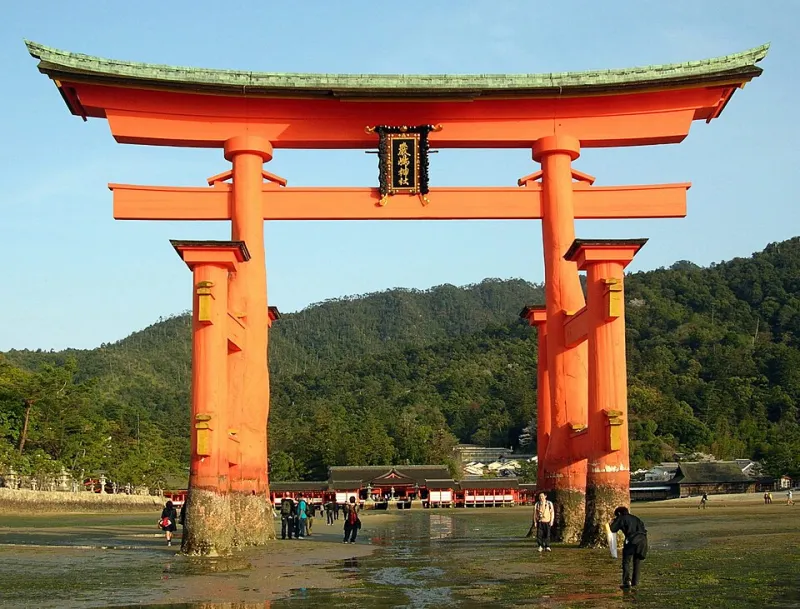
Photo: Bernard Gagnon, CC BY-SA 3.0, via Wikimedia Commons
Every element of a Shinto shrine — from the towering gate at the entrance to the twisted rope draped above the inner sanctum — carries a specific spiritual meaning rooted in centuries of Japanese religious tradition. For the culturally curious traveler, learning to read these symbols transforms a shrine visit from a passive sightseeing experience into a genuine act of understanding. This guide decodes the most significant architectural and decorative elements you will encounter across Japan's more than 80,000 registered shrines.
The Torii Gate: Threshold Between Worlds
No symbol is more immediately associated with Shinto than the torii — the distinctive two-posted gate that marks the entrance to virtually every shrine in Japan. Structurally simple yet visually commanding, the torii serves a purpose that is fundamentally cosmological: it delineates the boundary between the mundane world of everyday human activity and the sacred precinct of the kami, the divine spirits at the heart of Shinto belief.
The word torii is most commonly interpreted as meaning "bird perch," a reference to the mythological significance of birds as messengers between the human and divine realms. Stepping through a torii is understood as an act of transition — a conscious movement from the ordinary into the sacred. This is why proper etiquette calls for a slight bow before passing beneath the gate, an acknowledgment that one is entering hallowed ground.
Torii come in a variety of regional and stylistic forms. The myojin style, with its characteristic curved crossbeam and slight outward lean, is among the most common. The shinmei style, simpler and more austere, is associated with the oldest shrine traditions and is seen most notably at Ise Jingu. The vivid vermillion color of many torii is not merely decorative — red has long been understood in East Asian cultures as a color that wards off evil and signifies vitality and divine power.
Shimenawa: The Rope That Defines the Sacred
Strung across shrine entrances, wrapped around ancient trees, and draped over unusual rock formations, the shimenawa is a thick braided rope made from rice straw that performs one of Shinto's most fundamental symbolic functions: it marks the presence of the sacred.
In Shinto cosmology, the divine is not confined to temples or texts but is understood to inhabit the natural world — in mountains, rivers, ancient trees, and remarkable stones. The shimenawa serves as a visible declaration that a particular object or space has been recognized as a dwelling place of the kami. Where you see the rope, you are being told: pay attention, something divine resides here.
The twisted form of the shimenawa is also significant. The interweaving of strands represents the dynamic relationship between opposing forces — a concept that runs through much of Shinto thought. Hanging from many shimenawa are white zigzag paper streamers called shide, which amplify the rope's function as a spiritual boundary marker and are believed to attract and honor divine presence.
Komainu: The Guardian Pair
Flanking the approaches to most shrine main halls, visitors will encounter stone sculptures of lion-dog creatures seated in pairs. These are komainu, and their role is protective: they stand guard over the sacred space, warding off malevolent influences that might seek to disturb the kami within.
The two figures in a pair are almost always subtly different from one another. One typically has its mouth open, forming the sound "ah" (a), while the other's mouth is closed, forming the sound "un" (un or "m"). Together, they produce a-un, a concept analogous to the Sanskrit aum — the sound of the universe encompassing all of existence from beginning to end. This detail, easily overlooked by the casual visitor, reflects the profound cosmological thinking embedded in even the most seemingly decorative shrine elements.
At Fushimi Inari Taisha and other shrines dedicated to Inari, the deity of rice, prosperity, and foxes, the guardian figures take the form of foxes (kitsune) rather than lion-dogs. The fox in Shinto tradition is understood as a messenger of Inari, and its presence signals the particular spiritual character of the shrine.
Ema: Written Wishes and the Art of Letting Go
Hanging in clusters near many shrine halls, small wooden plaques covered in handwritten text represent one of the most personal and accessible aspects of shrine culture for visitors of all backgrounds. These are ema — votive tablets on which worshippers write their prayers, wishes, and intentions before hanging them at the shrine and leaving them in the care of the kami.
The word ema means "picture horse," a reference to the historical practice of donating live horses to shrines as offerings to the gods. Over time, painted images of horses on wooden tablets replaced actual animals, and eventually the plaques evolved into the personalized wish-boards seen today. Many ema are pre-printed with imagery related to the shrine's particular kami — foxes at Inari shrines, for instance, or rabbits at shrines associated with the moon deity.
For American visitors, the ema offers a rare and meaningful point of direct participation. Writing one's own wish or expression of gratitude — in any language — and entrusting it to the shrine is an act that requires no theological expertise, only sincerity. The practice of physically externalizing a hope and then releasing it is one that many visitors find unexpectedly cathartic.
Temizuya: The Purification Fountain
Before approaching the main hall of any shrine, visitors encounter the temizuya — a stone or wooden basin of running water flanked by long-handled ladles. This is the purification station, and the ritual performed here, known as temizu or chōzu, is among the most important preparatory acts in Shinto practice.
The correct sequence — ladling water first over the left hand, then the right, then rinsing the mouth, then allowing water to flow down the handle to cleanse it — is not arbitrary. Each step corresponds to a specific dimension of purification: the hands represent action, the mouth represents speech, and the overall ritual addresses kegare, the spiritual impurity that accumulates through the friction of daily life. Entering the shrine precinct without this cleansing would be considered disrespectful, akin to tracking the outside world into a space reserved for the divine.
Shirogane and Sacred Rock Formations
Perhaps the most ancient layer of Shinto symbolism is found not in constructed architecture but in the natural landscape itself. Many shrines are built around or oriented toward remarkable natural features — ancient trees, distinctive boulders, mountain peaks, or waterfalls — that were recognized as iwakura (divine rock seats) or himorogi (sacred groves) long before any permanent structure was built.
At these sites, the shimenawa rope and shide paper streamers are often the only human additions to what is essentially an unmodified natural altar. This simplicity is itself a profound statement: the divine does not require human embellishment. It is already present, already complete.
Seeing the Shrine Whole
Understanding these individual elements enriches every shrine visit enormously, but the deepest insight comes from recognizing how they work together as a unified system of meaning. The torii announces the threshold. The stone guardians protect the passage. The purification fountain prepares the visitor. The main hall houses the object of worship. The ema carries the visitor's intentions forward.
Each shrine visit, approached with this awareness, becomes less a sightseeing excursion and more a structured encounter with a living spiritual tradition — one that has been thoughtfully designed, over many centuries, to guide the human heart toward reverence, gratitude, and presence.