Dangling From Every Backpack: What American Omamori Fans Get Right—and Wrong—About Japan's Lucky Charms
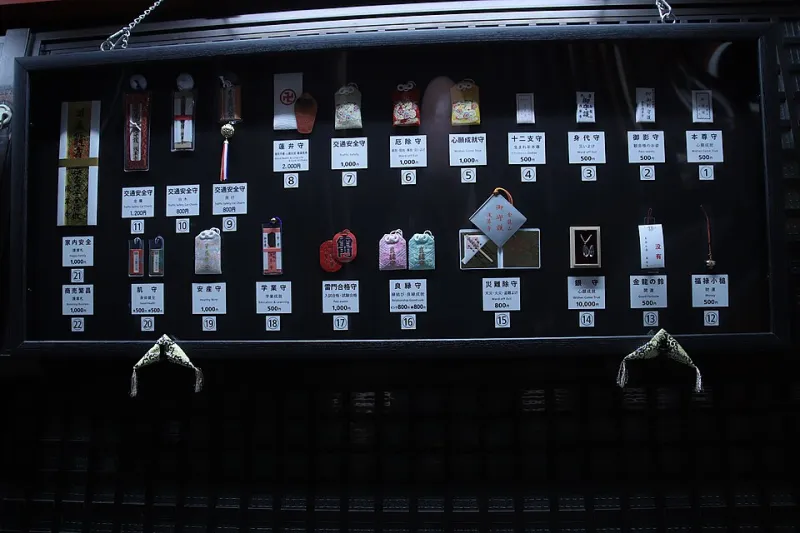
Photo: Cedric007, CC BY-SA 4.0, via Wikimedia Commons
Walk through any American college campus, farmers market, or indie coffee shop and you'll likely spot them: small brocaded pouches with knotted cords, dangling from zippers and keychains. Omamori—protective charms sold at Shinto shrines—have crossed the Pacific at scale, riding the same wave of Japan travel enthusiasm that filled flights to Kyoto over the past several years. Their popularity raises a fair question that deserves a more careful answer than either "cultural appreciation!" or "cultural appropriation!" usually allows: what does the tradition itself say about how these objects should be treated?
What an Omamori Actually Is
An omamori is not a souvenir in the casual sense. It is a vessel—typically a small silk brocade pouch containing a written inscription or strip of paper consecrated by shrine priests. The goshintai-like core inside is what carries the charm's protective function; the fabric is its housing. Charms are offered at shrines for specific purposes: safe travel, health, success in examinations, protection at home, prosperity in business.
Crucially, omamori are understood to have a working life. Traditional practice holds that a charm's protective power is not permanent, and shrines typically recommend returning old omamori to the shrine—often within a year or by the new year—to be respectfully burned in a ceremony called ondokusai. Retiring a charm is not discarding it; it is completing the relationship with gratitude.
Where American Practice Drifts
Against that framework, some popular American habits sit uneasily. Omamori marketed as fashion accessories—sold in boutiques far from any shrine, designed more for aesthetics than consecration—sever the object from its source. A charm clipped to a backpack after being purchased at an actual shrine is one thing; a mass-produced lookalike is another. The distinction matters less as a matter of gatekeeping and more as a matter of meaning: the object's power, in Shinto understanding, comes from ritual, not design.
Other drift points are more subtle. Omamori are traditionally carried on the person or placed where their purpose applies—a safe-driving charm in the car, a health charm near one's bedside. Turning them into tradeable collectibles, traded like trading cards or displayed in bulk like trophies, inverts their purpose. And the retirement ritual is almost universally unknown among American buyers, which means most charms abroad simply fade into drawers and junk cycles rather than returning to a shrine for proper closure.
What the Tradition Gets Right—and What Travelers Can Honor
Here is the more generous reading: the impulse behind the American omamori boom is not shallow. People are drawn to the idea that protection can be carried, that intention can be made physical, that a trip can leave something sacred in your pocket. That impulse is compatible with the tradition—it just asks for a few commitments.
If you carry one, buy it at a shrine, not a gift shop. Learn which blessing it carries and let that meaning matter. Keep it on your person or in the place it protects rather than treating it as decor. And when its year is up, don't toss it: mail it back if you can, hold it respectfully until you can return it, or at minimum retire it with thanks rather than trash.
Shrine priests I've spoken with on this topic tend toward pragmatism rather than indignation. The kami, one put it, are not keeping a scorecard of etiquette violations. But tradition exists for a reason: the practices around omamori—consecration, purpose, gratitude, retirement—are what transform a pouch into a protection. Honor the full arc, and the little brocaded bag on your backpack means something. Skip the arc, and it's just fabric with good marketing.
The choice, as ever with cultural exchange, is not whether to participate. It's whether to participate fully.